The AWAKEN wind farm benchmark – Part 2: Modeling results — UC Berkeley
1
The AWAKEN wind farm benchmark – Part 2: Modeling results — UC Berkeley
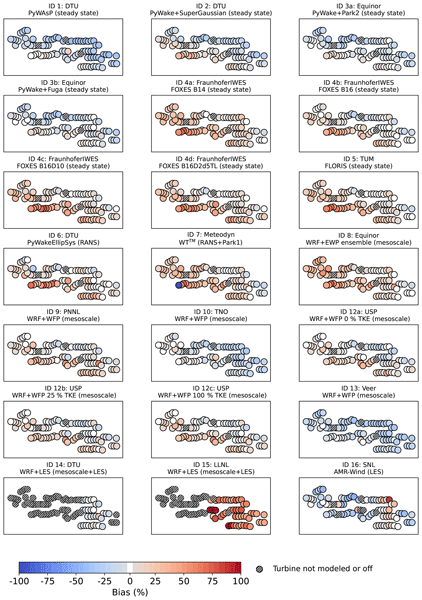
Abstract. Accurately modeling wind farm performance in complex atmospheric flows remains a challenge. This paper presents the modeling results of the American WAKE experimeNt (AWAKEN) wind farm benchmark, a collaborative effort involving 16 research groups from academia and industry within the International Energy Agency Wind Technology Collaboration Programme Task 57. The study evaluates a diverse suite of simulation tools, ranging from fast-running engineering wake models to high-fidelity large-eddy simulations, against a diurnal case study observed during the AWAKEN campaign. The benchmark utilized a three-phase structure to progressively assess model performance as observational data availability increased. Initial blind predictions showed that higher-fidelity models did not uniformly outperform simpler simulation tools in terms of aggregate error metrics; however, this largely reflects differences in inflow strategy rather than wake physics fidelity – simpler models directly ingested high-quality observations, while higher-fidelity models were tasked with predicting the inflow from coarser reanalysis boundary conditions. A distinct spatial bias was observed where models struggled to resolve the interplay between a low-level jet, wakes, and terrain-induced flow acceleration. In subsequent phases, access to progressively richer observational data enabled model refinement that reduced mean absolute error by up to 40 %; however, these gains primarily reflect state-conditioned calibration to a well-observed atmospheric state. Overall, the study demonstrates that inflow characterization defines a lower bound on achievable model accuracy that is independent of wake modeling fidelity – a finding with direct implications for pre-construction energy assessment workflows. While the limited ability to resolve local terrain-flow interactions under single-day conditions represents a recognized constraint, the findings on wake modeling and real-world validation still provide valuable guidance for model application and future benchmark design.
0 comments
No comments yet.