Discovering the mechanics of ultra-low density elastomeric foams in elite-level racing shoes — Stanford
SpringerLink
Discovering the mechanics of ultra-low density elastomeric foams in elite-level racing shoes — Stanford
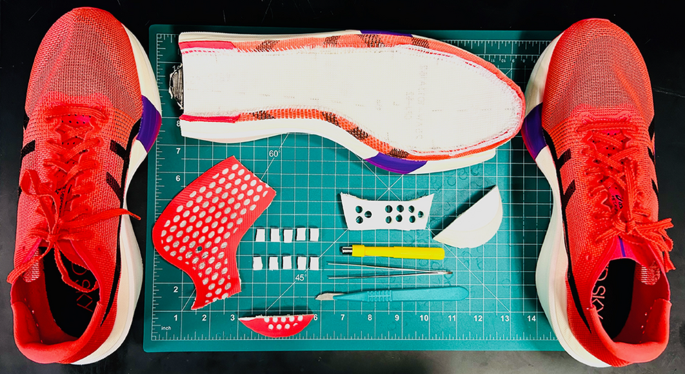
Ultra-low-density elastomeric foams enable lightweight systems that combine high compliance with efficient energy return. Their mechanical response is inherently complex, characterized by high compressibility, nonlinear elasticity, and microstructural heterogeneity. In high-performance racing shoes, these foams are critical for low weight, high cushioning, and efficient energy return; yet, their constitutive behavior remains difficult to model and poorly understood. Here we integrate mechanical testing and machine learning to discover the mechanics of two ultra-low density elastomeric polymeric foams used in elite-level racing shoes. Across uniaxial tension, confined and unconfined compression, and simple shear, both foams exhibit pronounced tension–compression asymmetry, negligible lateral deformation consistent with an effective Poisson’s ratio close to zero, and low hysteresis indicative of an efficient energy return. Quantitatively, at a strain rate of 0.25/s, both foams provide a similar compressive stiffness (E = 268±16 kPa vs. E = 299±29 kPa), while one foam exhibits a 42% higher tensile stiffness (E = 884±69 kPa vs. E = 623±96 kPa), and nearly double the shear stiffness (G = 219±20 kPa vs. G = 117±24 kPa), implying a substantially greater lateral stiffness at a comparable vertical energy return (83.3±1.5% vs. 88.9±1.8%). By integrating these data into constitutive neural networks, paired with sparse regression, we discover compact, interpretable single-invariant models–supplemented by mixed-invariant or principal-stretch based terms–that capture the unique signature of the foams with $${\textsf {R}}^{\textsf {2}}$$ values close to one across all loading modes. From a human performance perspective, these models have the potential to improve gait-level simulations with high-performance racing shoes to quantify running economy, performance enhancements, and injury risks on an individual athlete level. More broadly, this work establishes a scalable and interpretable approach for constitutive modeling of highly compressible, ultra-light elastomeric foams with applications to wearable technologies, soft robotics, and energy-efficient mobility systems. Source code, data, and examples are available at https://github.com/LivingMatterLab/CANN .
0 comments
No comments yet.